

 Resources


 Trending Articles


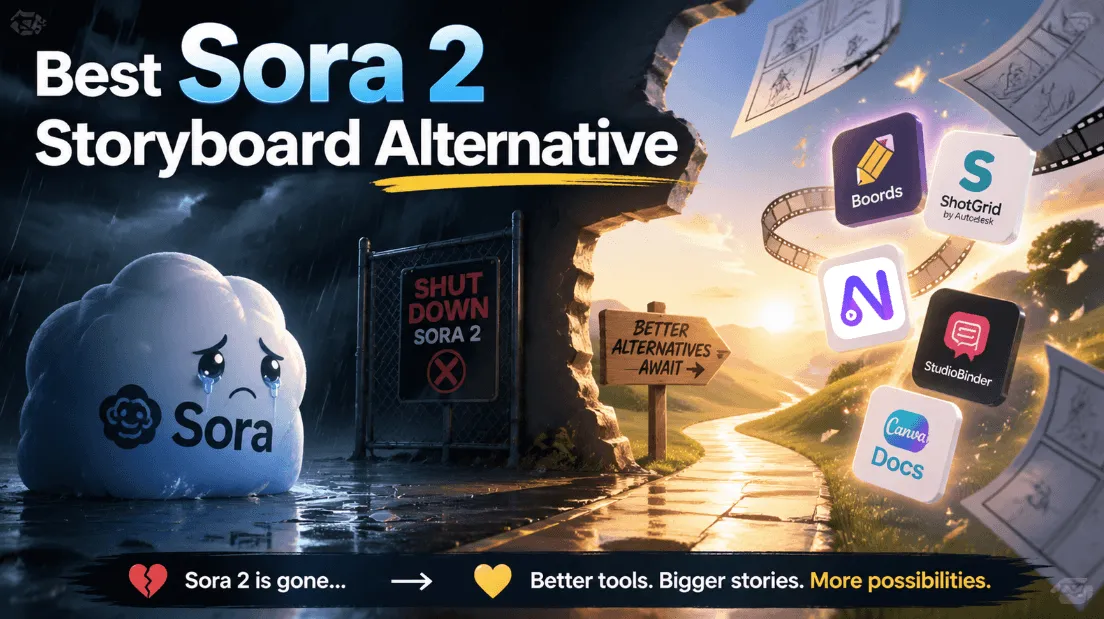
OpenAI recently announced that both the web and app versions of Sora will shut down on April 26, 2026, with API services ending on September 24, 2026. This news has left thousands of creators scrambling and asking: "What happens to my storyboarding workflow now?"
If you've been relying on Sora 2's Storyboard feature to transform scripts into multi-scene, narrative-driven videos, you're definitely not alone in feeling frustrated. I've been there too—it's disruptive when a tool you've integrated into your creative process suddenly becomes unavailable.
The good news? Novi AI—a solution designed specifically for script-to-storyboard video creation—offers longer video durations, greater creative control, and has Sora model via API.

What is Sora 2 Storyboard
Sora 2 Storyboard was a streamlined video workflow feature within OpenAI's Sora 2 Pro that allowed creators to build structured, multi-scene videos. Think of it as a simplified AI director tool that handled script breakdown, scene planning, shot composition, character consistency, and timing control—all producing an exportable video file at the end.
Instead of typing one massive prompt and hoping the AI interpreted your vision correctly, Storyboard let you break your video into multiple "cards" or scenes arranged along a timeline. Each scene had its own brief description specifying exactly what should happen at that moment—much like creating a shot list for a film. The AI then stitched these scenes together into a cohesive video up to 25 seconds long, making it ideal for short stories, marketing clips, or any content requiring a clear beginning, middle, and end.
How to Use Sora 2 Storyboard

Before the shutdown, ChatGPT Pro users could access the Sora 2 Storyboard interface through the official Sora website. You could set the duration of each scene, add camera movement details like panning or zooming, and even upload reference images to maintain consistency in characters, scenes, and style across different shots. This helped solve the frustrating problem of AI videos unexpectedly changing between scenes.
However, even with these controls, the maximum video length was only 25 seconds—which felt quite limiting for many narrative projects.
Why People Are Finding Sora 2 Storyboard Alternatives
Honestly, people started looking for Sora 2 Storyboard alternatives long before the shutdown announcement. The shutdown just accelerated an existing trend. Here's why:
Access Limitations: Sora 2 Storyboard was locked behind a ChatGPT Pro paywall at $49.99/month and only worked in select countries like the US, Canada, and Japan. It was blocked in the UK and EU due to regulations, leaving many creators unable to access it at all.
Restrictive Length: The 25-second video limit was a dealbreaker for many projects. Most narrative content simply needs more time to develop properly.
Slow Generation: Multi-scene storyboards took 3–5 times longer to generate than single-scene videos, which slowed down creative workflows considerably.
Character Consistency Issues: Despite the reference image feature, maintaining consistent characters across scenes remained challenging.
Missing Features: Many creators wanted better collaboration tools, longer video capabilities, easier audio syncing, and features specialized for social media content that Sora simply didn't offer.
Plus, alternatives often cost less, worked globally, and provided the specific features creators actually needed for their workflows.
Understanding the Difference: Short Video Models vs. Storyboard Workflows
Before diving into alternatives, it's important to understand what you actually need to replace. If you simply need short AI-generated animation clips, tools like Veo, Kling, or Runway might suffice. However, if your goal is converting a script into a structured, narrative-driven storyboard video, you need more than just another video model—you need a complete storyboard workflow solution.
| Category | Short Video Clips | Storyboard Videos |
|---|---|---|
| Key Features | Single-prompt generation; focused on high-fidelity physics, realistic motion, and immediate visual impact in one continuous shot | Multi-frame control; allows defining specific scenes or keyframes to ensure narrative continuity and consistent characters across cuts |
| Example Tools | Runway Gen-4.5 (cinematic quality), Google Veo 3.1 (native audio), Kling AI 3.0 (physics/motion) | Luma Dream Machine (long sequences), Seedance 2.0 (multi-shot consistency) |
| Best For | Social media hooks, B-roll footage, creative experiments, fast visual iterations | Commercials, short films, pre-visualization, story-driven content with specific scene sequences |
Most "Sora alternatives" focus on replacing the model itself. What storyboard users actually need is workflow replacement: script breakdown, scene planning, shot composition, character consistency, narration, timing control, and exportable video files.
Best Sora 2 Storyboard Alternative: Novi AI
After testing various best storyboard AI options, I want to introduce Novi AI—which I believe is the best solution for creators who specifically need storyboard workflow capabilities.
What Makes Novi AI Different?
Novi AI is built specifically for narrative video creation. It's a comprehensive script-to-video generation platform that transforms text prompts and detailed scripts into professional videos up to 5 minutes or longer. Rather than just being another video generator, it's designed as a complete narrative video production system.
Key Features:
- Video Agent for Narrative Content: This is the core feature for storyboard workflows. It supports AI story expansion, unified visual style across scenes, character consistency, shot consistency, audio-visual synchronization, and natural dialogue between characters. You can create in multiple languages and styles with built-in narration support.
- Multi-Model Integration: Access over 30 leading AI models on a single platform, including Seedance 2.0, Google Veo 3.1, Kling 2.5, Sora (via API—currently still operational), Runway, and more. This means you're not locked into a single model's limitations.
- Complete Script-to-Video Workflow: From concept to script, storyboard, and final video—everything happens in one place with features specifically designed for narrative content.
- Advanced Creative Controls: Character consistency tools, narrative camera angles, dialogue generation, AI voiceover, AI lip sync, and multi-language support.
- AI Image Generator: Access leading image models for storyboard planning—including GPT Image 2, Seedream, and Nano Banana—for text-to-image and image-to-image generation.
- Beginner-Friendly: Despite its powerful features, the workflow is designed to be accessible for creators without advanced video editing skills.
Sora Storyboard vs. Novi AI Comparison
| Feature | Sora 2 Storyboard | Novi AI |
|---|---|---|
| Multi-scene planning | Yes | Yes |
| Script-to-storyboard workflow | Limited/Manual | Core Feature |
| Script-to-video | Yes | Yes |
| Long-form video generation | Limited (25 sec max) | Yes (5+ minutes) |
| AI Voiceover | Limited/Not Core | Yes |
| AI Dialogue Generation | Limited/Not Core | Yes |
| AI Lip Sync | Limited/Not Core | Yes |
| Multi-model workflow | Sora-focused | 10+ Models |
| Social Video Templates | Limited | Yes |
| Designed for Narrative Content | Partial | Yes |
How to Use Novi AI to Create Script-to-Storyboard Videos
Step 1Sign Up and Claim Your Free Credits
Visit the Novi AI homepage and sign up to receive 80 free credits. You can earn an additional 100 credits by joining the Discord community.
Try It OnlineStep 2Use Video Agent to Generate Your Storyboard
If you already have a script, select the "Video Agent" feature. After entering your script, the system automatically generates character profiles and storyboard images. Note that parsing your script and segmenting scenes may take a few minutes.

Step 3Review and Confirm Generation
Once generation is complete, you'll see a confirmation screen displaying the selected AI model and associated credit cost—full price transparency before you commit. After confirmation, the video content generates and becomes available for export.

Step 4Test Specific Scenes with Advanced Models
For testing specific clips or scenes, try the GPT-Image-2 model. It excels at structured composition and text-to-image accuracy. Use it to generate storyboard images based on your desired scenes and reference images, then feed those into the Seedance 2.0 model, which specializes in narrative-driven shots and character consistency.
Frequently Asked Questions
1Can I still use Sora 2?
Unfortunately, even ChatGPT Pro subscribers can no longer access the official Sora 2 website. Only platforms with API partnerships remain operational, and those services are scheduled to end by September 2026.
2What is the best alternative to Sora Storyboard?
Based on my testing and experience, I recommend Novi AI for creators specifically focused on storyboard workflows and narrative video content.
3Who should use Novi AI?
Anyone creating episodic content—specifically videos featuring recurring characters, continuous storylines, and consistent character visuals across scenes. It's ideal for short films, web series, educational content, marketing campaigns with narrative arcs, and social media storytelling.
4Is Novi AI just another AI video generation platform?
No. While it aggregates leading AI models, what sets it apart are the "AI Agent" features designed specifically for long-form video production. The platform is built to empower users to become their own "AI Directors," creating narrative-driven video content with the control and consistency that storytelling requires.
5Can I get started for free?
Yes, Novi AI offers special perks for new users upon registration, including initial credits to test the platform.
Conclusion
The Sora 2 shutdown is undoubtedly disappointing for creators who integrated it into their workflows. However, it's also an opportunity to discover tools that may actually serve narrative video creators better in the long run.
If you're specifically looking to replace Sora's storyboard functionality—not just generate short video clips—Novi AI offers a more comprehensive solution with longer video durations, better character consistency, multi-model flexibility, and features designed from the ground up for storytelling. From my experience testing various alternatives, it's the closest thing to having an AI assistant that actually understands narrative structure and helps you direct rather than just generate.
The transition might feel disruptive now, but with the right alternative, your storyboarding workflow can actually become more powerful than before.
Was this page helpful?

Article by
Aaron Smith


![Best AI Animation Tools in 2026: Top 5 Platforms Compared [Free & Paid]](https://images.noviai.ai/noviaien/assets/article/story-tips/best_ai_animation_generator.webp)